Glyn Takes The Lead
This started off very much as “Glyn’s day of research”. It was also a day of First World War Cemeteries. Perhaps, inspired by some of the work that I’d been doing & that he has helped with, Glyn had recently dug into his own family history and found that one of his Great Uncles was a casualty of the First World War. His Great Uncle was buried in the CWGC Cemetery at Marfaux. This is not too far from Reims – hence our journey there. So, this morning we set out for Marfaux to find the Great Uncle’s grave.
Champagne on the hills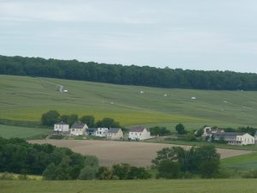
We were now travelling through the Champagne Region of France. This is evident by the huge number of vineyards on the hills. Each with their own little white van & people out checking on the state of the grapes. As neither of us are great lovers of the drink, we decided not to stop & taste, but to continue to Marfaux.
Marfaux and two WW1 cemeteries
There are two First World War cemeteries here. The Commonwealth one & right next door a German one. In the latter there are sim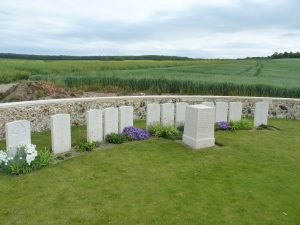 ple crosses for the majority of burials but “proper” headstone for those of the Jewish religion. It’s generally forgotten how many Jews fought for Germany in the First World War given what happened to them during the Second. The other surprise is that there are 4 burials per cross!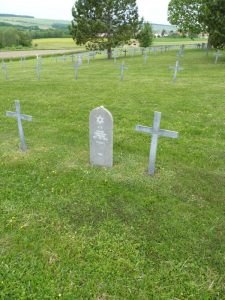
A team from the CWGC was on site mowing the grass & generally tidying up the area as we arrived. We were able to find Glyn’s Uncle’s grave.
However Glyn had discovered that this wasn’t where he’d died. Apparently, he’d been involved in the fighting in many places. His regiment being moved around to react to the German attacks. Records showed that he actually died in a hospital in a place called Montigny sur Vesle.
We’re not sure whether he was already at the hospital when the Germans over-ran it or whether he was wounded during the fighting and was taken there afterwards. Whichever way he got there, he died as a PoW.
Northwards to Montigny.
We had a bit of a look around Montigny, but weren’t getting anywhere in finding the hospital. So we decided to visit the local Marie where, in our Officer Crabtree French, we explained what we were looking for.
We received directions towards the next hamlet – of Vanteaux – where the hospital had once been. This fact was recorded in a booklet on the history of the area. Apparently, these are normally reserved for couples getting married in the area. However as Glyn was researching his Great Uncle, they allowed us to purchase a copy.
L’Homme Mort
We then set off for Venteaux. The map that we’d been given showed an area marked as L’Homme Mort – the Dead Man. We wondered whether this was related to the hospital. At the site we took a few photographs then set off towards our pre-lunch destination of the Forêt de Compiègne.
The site of the Armistice
This is where the Armistice to signify the end of the First World War was signed in 1918. The si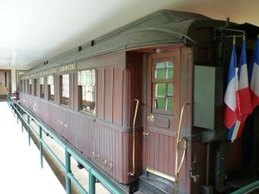 te was used again in 1940
 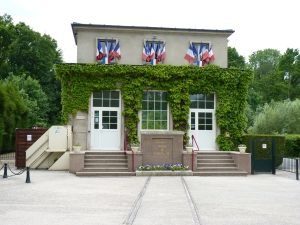 for France’s formal surrender to the Germans. In the very same railway carriage that had been employed for the 1918 signings. There’s now a museum which, amongst other things, contains a replica of the railway carriage. The or
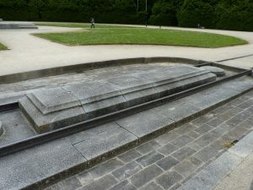 iginal was taken to Berlin where it was put on display. It had been destroyed in 1945. Markers outside the museum show the location of the various carriages in 1918.
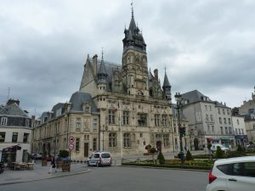
Then it was to lunch in Compiègne, itself.
Followed by the completion of our journey to Rouen & the Chant du Loup.




Recent Comments