Pte Sammy Brunt 14217219
1st Battalion Hampshire Regiment
Summary
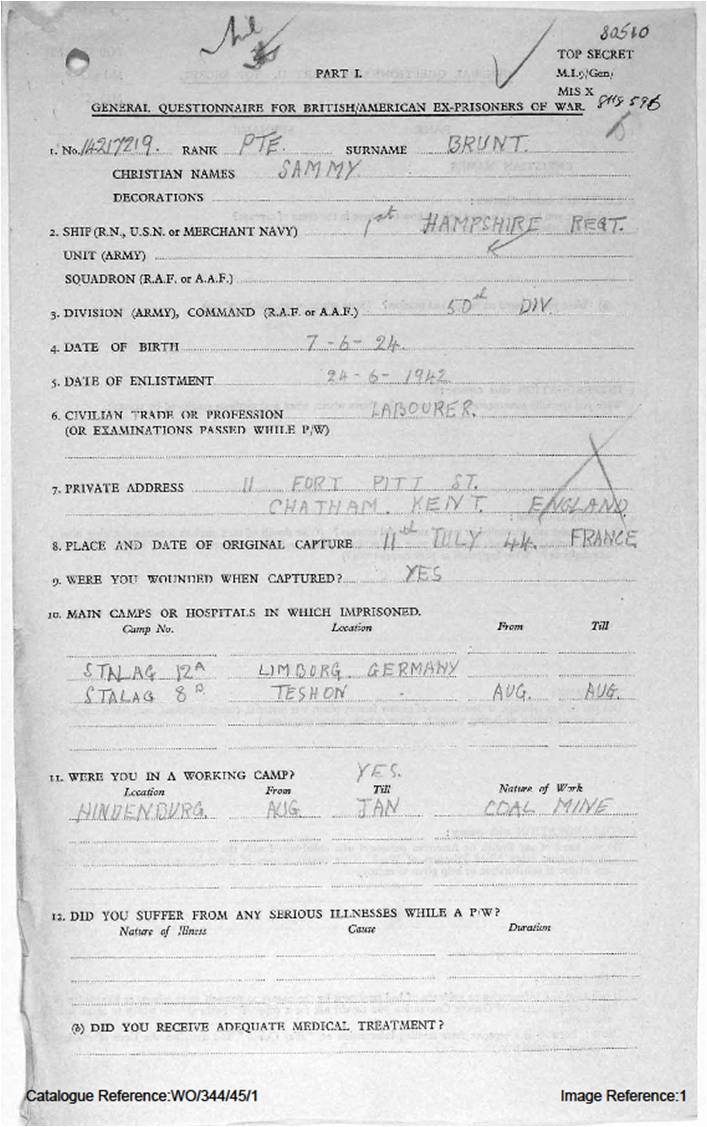
Sammy Brunt was born in Kent in 1924. He enlisted in June 1942. At the time of his capture on the 11th of July 1944 near Hottot he was with the Hampshire regiment. On his returning PoW questionnaire he states he was wounded on capture. He also records that he was at Stalag XII-A Limbourg and Stalag VIII-D Teschen – from there assigned to the work camp at Hindenburg coal mine. After the war he returned to Chatham and worked in the demolition trade. He married in 1947 and the couple appear to have had three children. He died in November 2007.
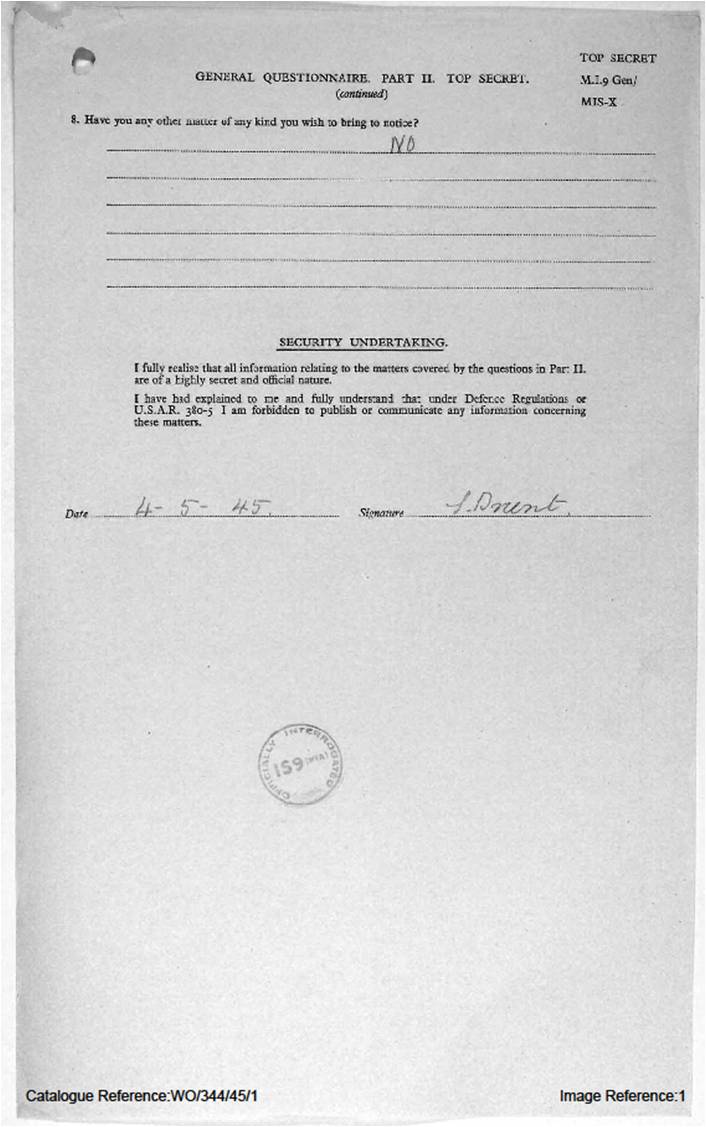
[See the signature – click on the pictures to enlarge the image]
Early Life
Sammy Brunt was born in Chatham, Kent on the 7th of June 1924 the youngest of four brothers. Sadly, two of those brothers died before the 1939 Register was published. In that Register he was recorded as a yard boy at His Majesty’s Dockyard Stores. His date of birth is wrongly recorded as 1914. His father is described as a blacksmith labourer. The family was living in Cage Lane at that stage – in 1945 he gives his address as Fort Pitt Street.
Service Life
On his returning PoW form he states that he enlisted on the 24th of June 1942 (he had turned 18 on the 7th). He gives his occupation on enlistment as a labourer.
He would have gone through initial training for six weeks with the General Service Corps before being assigned to a Regiment and could have gone into front-line service soon after as the age restrictions on overseas deployment had been lifted.
We know that he is with C Coy 1st Battalion Hampshire Regiment when captured but we do not know when he was transferred to the Regiment.
The 1st Battalion was war-hardened by D-Day. At the outbreak of hostilities, it had been deployed in India. In December 1939 it was moved to Egypt to take part in the North Africa Campaign. February 1941 it was deployed to Malta, alongside the 2nd Devon’s and the 1st Dorset’s. In July 1943 it would take part in the invasion of Sicily -establishing the beachhead at Marsamemi (which resulted in heavy casualties) before advancing through the island. The Regiment would also feature in the subsequent campaign on the mainland of Italy.
On 23 September, the Battalion was withdrawn from the campaign arriving back in England on the 4th of November 1943 (after 22 years overseas). The bravery and perseverance displayed by the Regiment in those campaigns is said to have been what convinced Montgomery to use them in a pivotal role in the Normandy Landings.
Time in Normandy
On D Day, after standing ready aboard ship from the 3rd of June, the Battalion landed on the Jig sector of Gold Beach a little East of where was planned, one of the first if not the first detachment to land, taking the village of Le Hamel East at about 1700hrs and then Arromanches as part of 231 Brigade, 50th Division, C Coy well to the fore in most of the fighting. The Regiment took heavy losses (182 casualties). Unsurprisingly the War Diary does not have the detail that some others display as the Battalion lost its C/O and his second in command shortly after landing.
Moving south they were involved in several engagements suffering many casualties. They dug in North of Hottot les Bagues on the 19th and settled into testing the enemy’s positions with a series of fact-finding patrols.
They were still in this area when Bird and Brunt were captured on the 11th of July. A statement by a L/Sgt Mermagen, attached to the missing personnel report, states that the two were part of “1 Section” covering a gateway onto a lane in front of the Company. The last Mermagen saw of them was standing by the gate with their hands up being urged to move into the lane by a German soldier. At least two other soldiers – Harry Hyde and Joseph Wright were taken prisoner that day but died of their wounds. A fifth soldier was marked as located. Thirty-six other soldiers from the 1st Battalion lost their lives that day.
[See the blog: Capture Site]
PoW Life
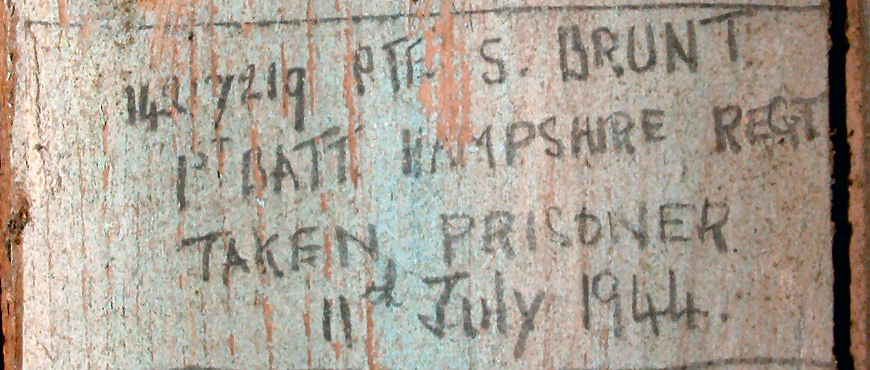
After capture he spends some time at “the shed”. It is likely that the route from there would have been that described by Elledge until Chartres, there after Châlons-sur-Marne (now Châlons-en-Champagne) and Stalag XII-A Limbourg, which functioned in part as a processing camp, he was taken to Stalag VIII-B Teschen (Cieszyn, Poland) and given PoW number 83248. He states that he was then assigned to the coal mine at Hindenburg.
Brunt would have taken part in the Long March of early 1945 – the inmates of this camp being marched either to Stalag XIII – C in Bavaria, XIII-D Nuremburg, or Stalag VII-A Moosburg. The March initially set out North towards Dresden before a change in plan saw it arcing south towards Nuremburg. Many were on this march for 12 weeks or so. The temperatures in January and February 1945 were the coldest recorded for a century in that area.
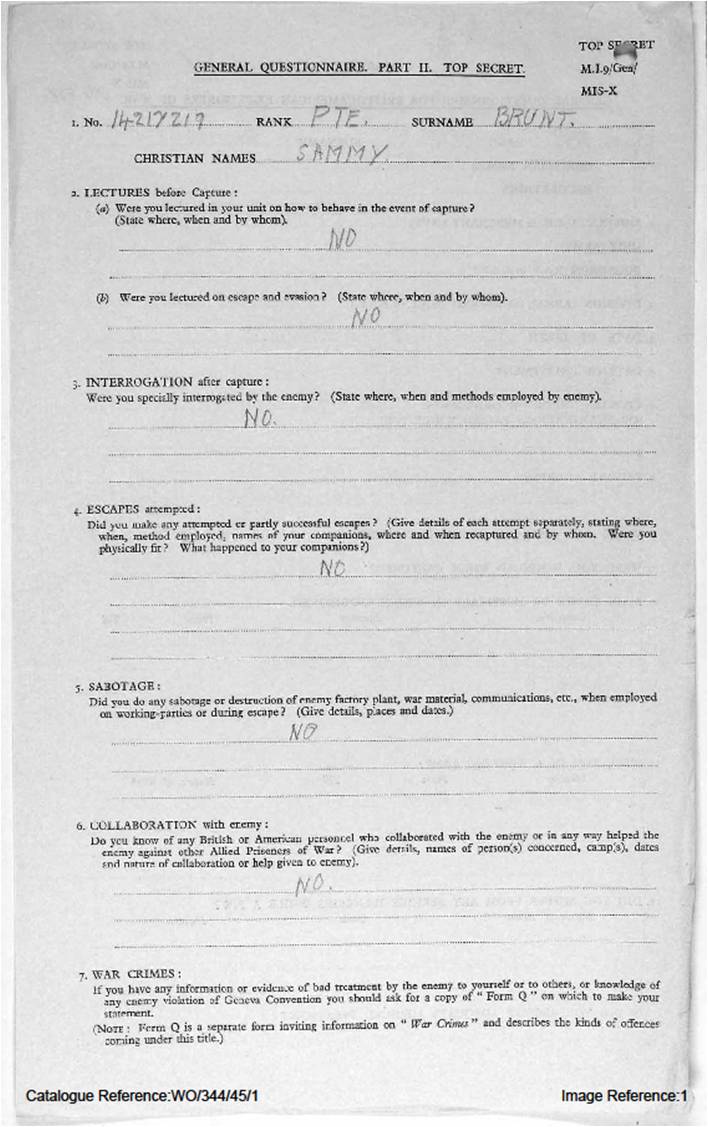
We have not found a German PoW card for Brunt at the National Archives but there is a returning PoW form.
Post War
Brunt was released from the army soon after the end of hostilities and returned to Chatham in Kent.
A phone-book entry suggests that he set up in the demolition business.
He married in December of 1947 and the couple had at least three sons.
An Ancestry contact suggested that later the family owned many properties – in part through inheritance.
Brunt died on the 28th of November 2007.
Research Done
Efforts have been made to contact various members of his immediate family by post, but none have proved successful.
Other Links
Brunt shed writing [return to info]
Hampshire Regimental Badge [return to info]
Brunt returning PoW questionnaire [return to info]