Pte John Basil Ivan Bird 14215934
1st Battalion Hampshire Regiment
Summary
John Basil Ivan Bird was born in December 1924. He lived in Hendon in Middlesex. John enlisted sometime after his 18th birthday in December 1942 and was posted to the Hampshire Regiment. He was captured on the 11th of July 1944 near Hottot and was sent to Stalag VIIIB Teschen and suffered the privations of the “Long March” in early 1945. In later life he is described as a company director residing in Bexhill on Sea, East Sussex. He died in 1976 aged 51.
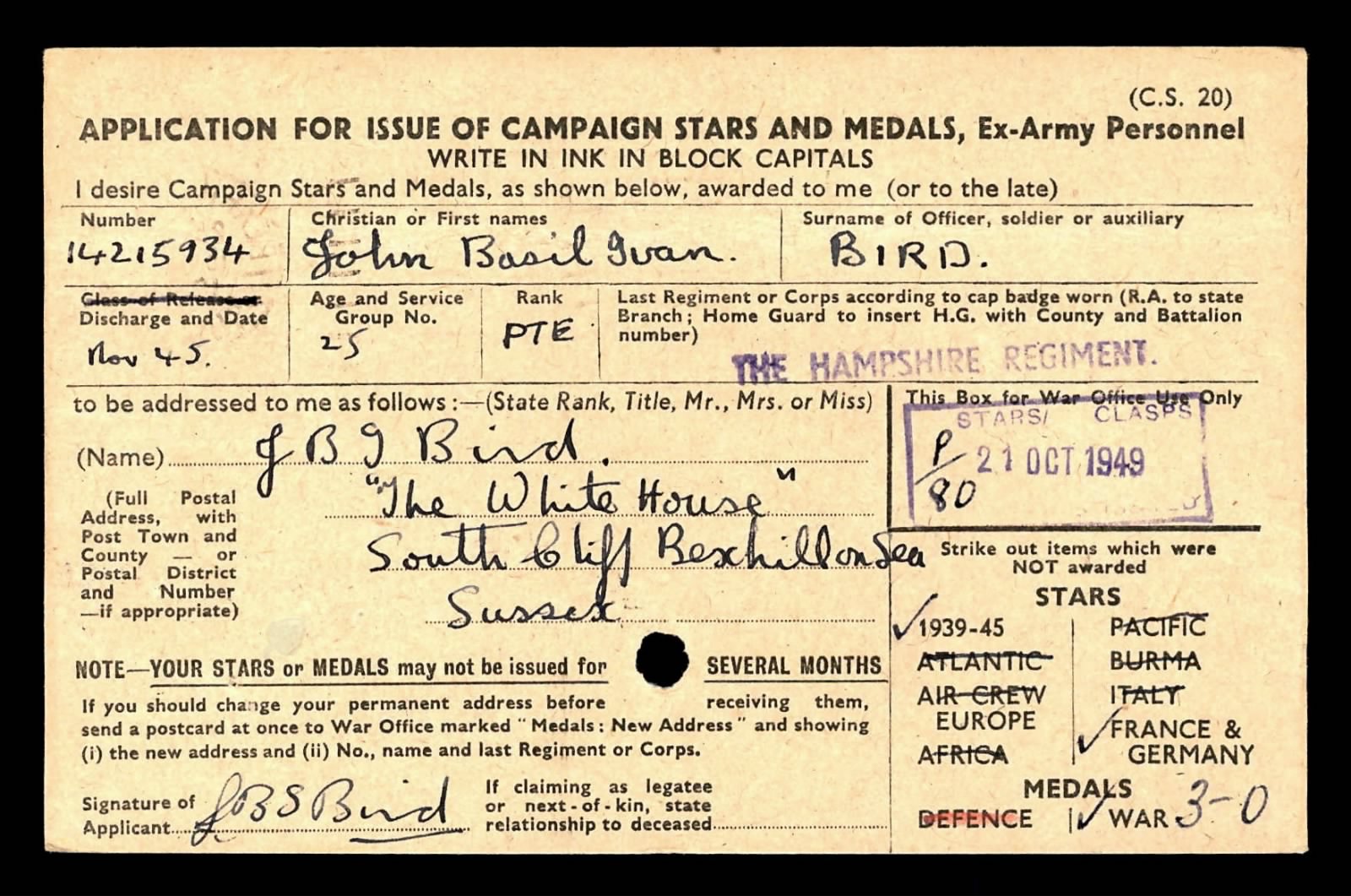
[See the signature – click on the picture to enlarge the image]
Early Life
John Basil Ivan Bird was born on 18 December 1924. His birth was registered in Westhampton, Sussex in the January quarter of 1925. He is registered as John I B Bird. Both parents came from the Hendon/ Wimbledon area where the extended family held a large amount of property. His mother’s family (Haynes) had a particularly strong local presence for many years, and at this time, amongst other property, still owned a hotel and ran the local brickworks.
In the 1939 Register Bird is recorded as John I B Bird “at school”. It is not clear why later records transpose the middle names. The family were then living at 173 Ealing Road Alperton, Wembley.
His father had fought in WW1 in the Royal Garrison Artillery and in January 1918 he had been invalided out as a Lance Bombardier due to sickness. The father’s service file initially gives an address at Pagham near Bogner which is later amended to Glenmore, Alperton, Wembley (his wife’s parents’ address) and describes him as a farmer. On the 1939 Register he is recorded as being an Estates Manager. He died on 13th August 1944 a month after his son became a POW (officially missing believed a PoW at that time).
Ancestry suggests that Bird had four older sisters (a brother had died shortly after birth in 1925) two were living at home on the 1939 register.
Service Life
Bird’s army service number is in line with joining up some time after his 18th birthday – though anomalies do occur with these numbers. Initial training would be through the General Service Corps. At some stage thereafter he is assigned to C Coy 1st Battalion Hampshire Regiment. It is not clear when he joined the Battalion – it could be straight from initial training or as late as during the Normandy campaign.
When war broke out the Battalion was deployed in India. It was then deployed in the North Africa Campaign. February 1941 moving to Malta, alongside the 2nd Devon’s and the 1st Dorset’s. Taking part in the invasion of Sicily in July 1943 – establishing the beachhead at Marsaemi (suffering heavy casualties)- and the advance through the island. The Regiment was also to feature in the subsequent campaign on the mainland of Italy.
On 23rd of September the Battalion was withdrawn from the campaign arriving back in England on the 4th of November 1943 (after 22 years overseas). The bravery and perseverance displayed by the Regiment in those campaigns is said to have been what convinced Montgomery to use them in a pivotal role in the Normandy Landings.
Time in Normandy
On D Day, after standing ready aboard ship from the 3rd of June, the Battalion landed on the Jig sector of Gold Beach a little East of where was planned, one of the first if not the first detachment to land, taking the village of Le Hamel East at about 1700hrs and then Arromanches as part of 231 Brigade, 50th Division, C Coy well to the fore in most of the fighting. The Regiment took heavy losses (182 casualties). Unsurprisingly the War Diary does not have the detail that some others display as the Battalion lost its C/O and his second in command shortly after landing.
On the 10th a ”mopping up” action around St Paul De Vernay started, continuing next day into the area of Bernieres Bocage. The Regiment were in that area until the 13th , facing German counter attacks that caused heavy casualties, before moving to La Senaudiere. Again heavy fighting ensued. They stayed there until moving on Lingevres on the 19th. They dug in North of Hottot and settled into testing the enemy’s positions with a series of fact finding patrols.
They were still in this area when Bird and Brunt were captured on the 11th of July. A statement by a L/Sgt Mermagen, attached to the missing personnel report, states that the two were part of “1 Section” covering a gateway onto a lane in front of the Company. The last Mergamen saw of them was standing by the gate with their hands up being urged to move into the lane by a German soldier. Harry Hyde (6479409 interred at Bayeux) and Cpl Joseph Wright (5388124 interred at Tilly) were on the same missing list as Bird and Brunt but as prisoners died of wounds on the 11th. A fifth was descibed as located. 36 members of the Battalion died that day.
PoW Life
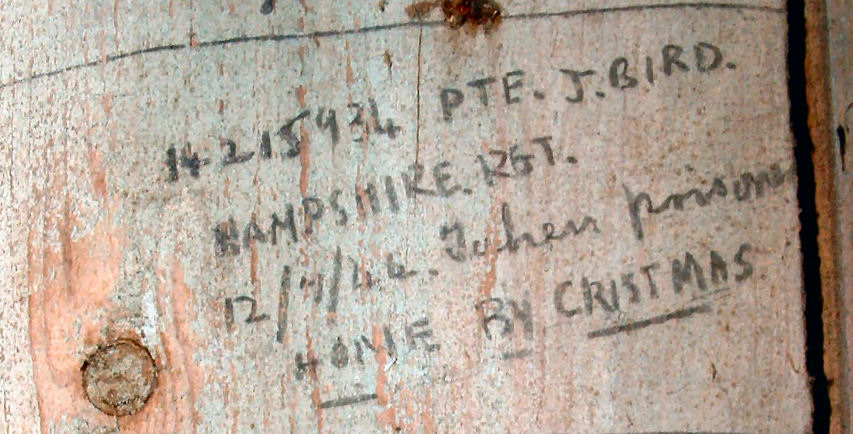
Obviously, we know that on route to a German PoW camp Bird spent some time at “the shed”. Other than that, his route is merely speculation, but is likely to have been a similar route to as that described by Elledge as far as Chartres, then, being infantry, to Châlons-sur-Marne (now Châlons-en-Champagne) and hence to Stalag XII-D Limbourg, which seems to have been used, in part, as a clearing station for infantry prisoners.
He was sent to Stalag VIII-B Teschen (Cieszyn, Poland) and given PoW number 82950. Most of the prisoners at Taschen were assigned to various associated work-camps.
He would also have taken part in “The Long March” of early 1945. After setting out North towards Dresden the march from this camp would arc south when the Germans had a change of mind, taking the prisoners to either Stalag XIII -C in Bavaria, XIII-D Nuremburg, or Stalag VII-A Moosburg. For many The March would last the best part of three months. In this area January and February that year were the coldest recorded that century.
There is a German PoW card at the National archives in the name John Basil Iuan Bird with a 1924 date of birth that at present is closed until 2025 – the third name is different but that would be an easy transposition error to make (it could even be Bird saying no that’s Iuan to avoid having a Russian name).
We do not have a returning POW form for Bird. Brunt’s form is dated 4th of May 1945 and it is likely Bird was repatriated at a similar time (so much for “HOME BY CRISTMAS” (sic) as scrawled by him on the shed wall).
Post War
It seems that Bird was demobbed in the normal way shortly after the end of the war.
He married in 1945 in Hendon. The couple had at least one daughter.
His address is listed as The White House (37) South Cliff Bexhill on Sea on his claim for medals. His mother is listed at that address in the phonebook, and it is only after her death in 1961 that Bird is so listed.
[See the image of his medal claim form]
On the probate register for his mother he is described as a company director.
He died on the 17th of September 1976 at the early age of 51.
Research Done
Other Links
Bird shed writing [return to info]
Hampshire Regimental Badge [return to info]
Bird medal claim form [return to info]