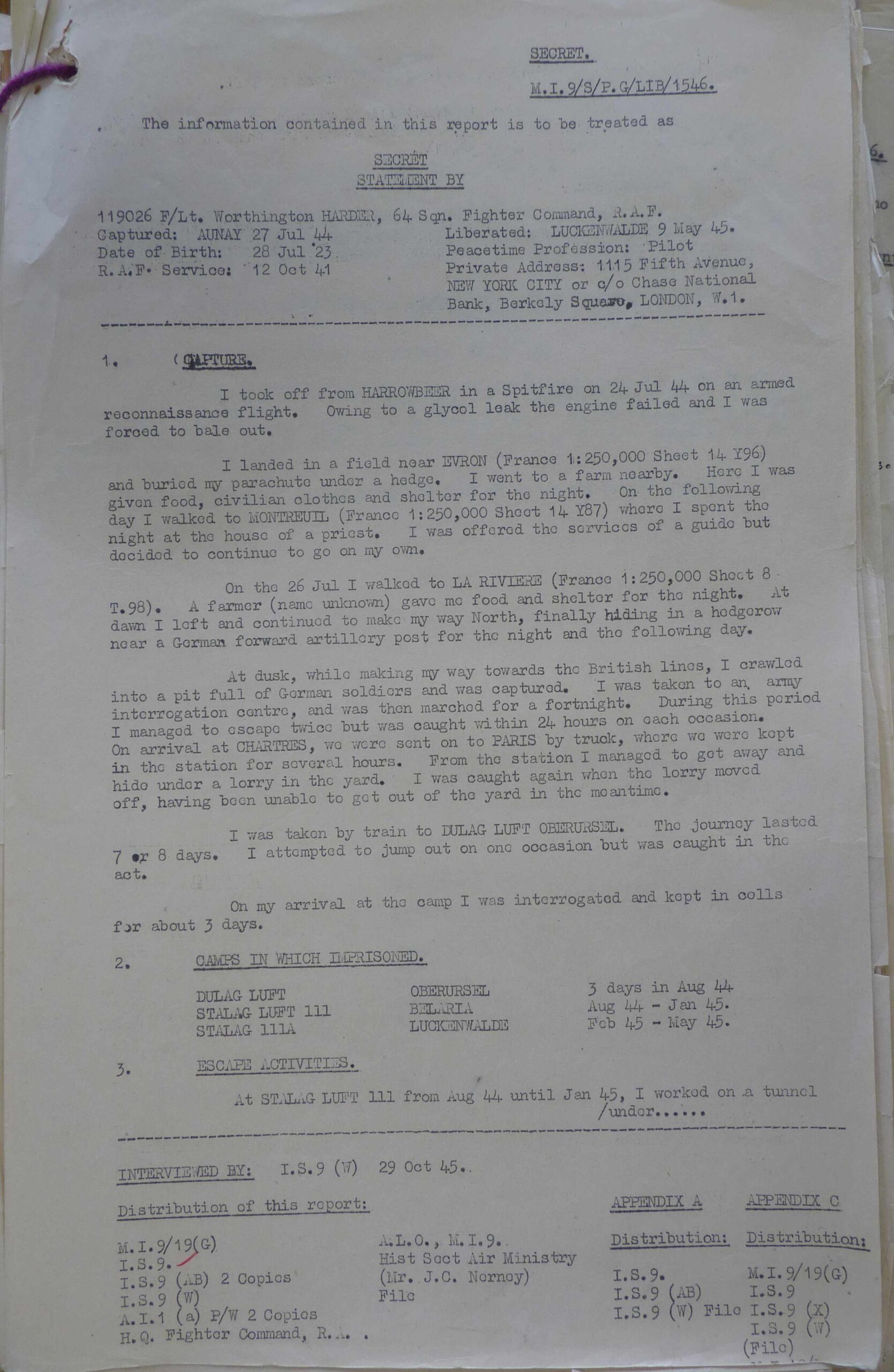
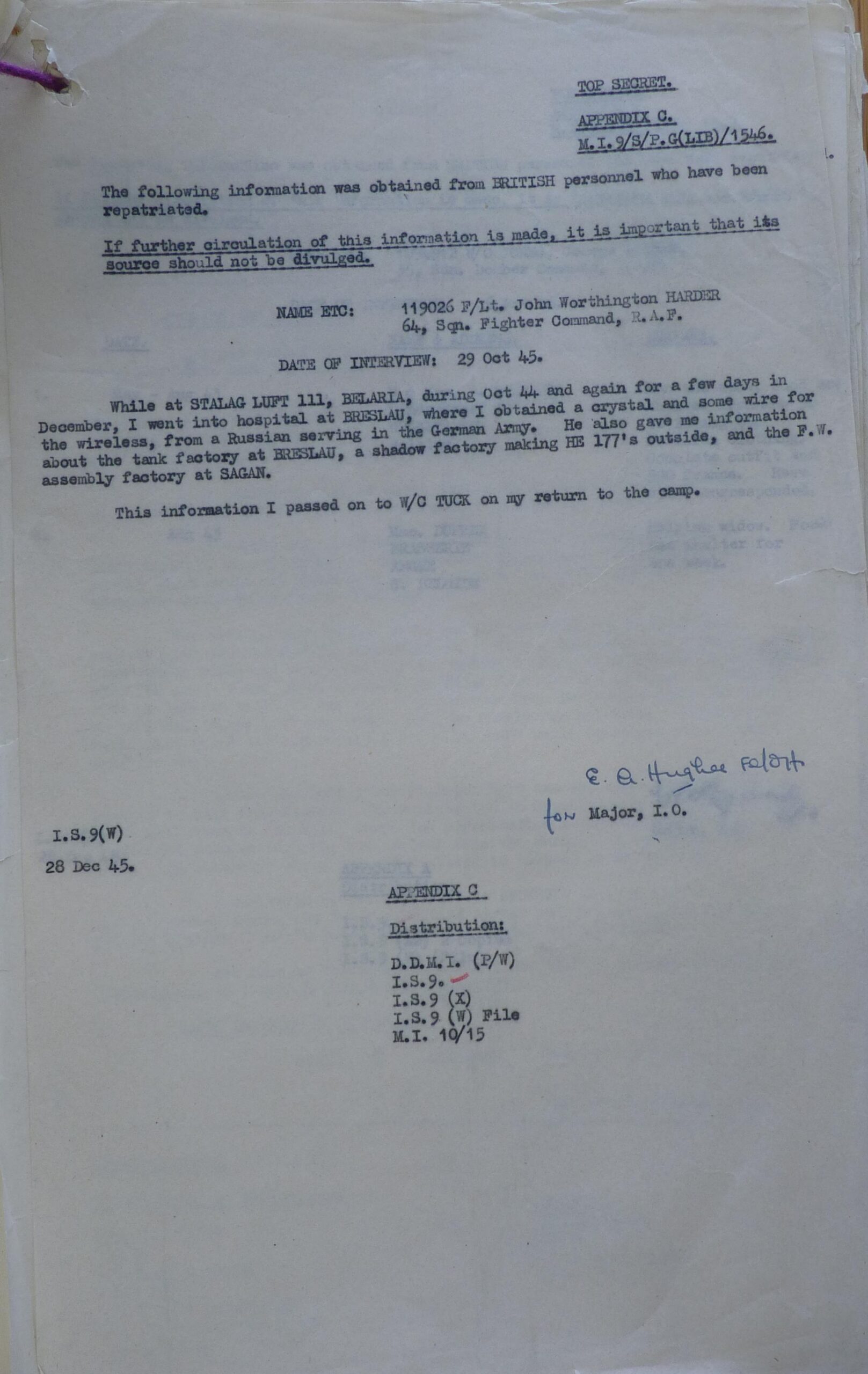
Flt Lt John Worthington Harder 119026
64 Squadron, RAF
Summary
Born in New York in 1923, John Worthington Harder joined the RAF before Pearl Harbour and chose to remain with the RAF when America entered the war.
Arriving in England early 1942 he had brief spells in Coastal Command and Heavy Bombers before being grounded with sight problems. Contact lenses corrected his short-sightedness but worsened his night vision leading to a re-muster to Fighters.
He joined 64 Squadron late February 1943 to fly spitfires, rising to become a Flight Commander, earning the nickname “Junior” in view of his age.
On the 24th of July 1944 he was shot down on a sweep near Evron, Mayenne, France and, after an attempted evasion, was captured and remained a prisoner for the rest of the war, mainly at Stalag Luft III.
Post war, after a brief period in the RAF, he returned to the States, married, and began a career in civil aviation, instructing in the Middle East, setting up several airlines and working as a test pilot for Boeing. He died in 1977 in Seattle.

Early Life
John Harder was born in New York on the 28th of July 1923, the fourth of six siblings.
John was fascinated with flying from an early age; His first solo flight was in Palm springs whilst on vacation at the age of 14.
His parents separated in the early thirties and both remarried, John and his siblings living with their mother and stepfather in New York. A further half sibling arrived in 1936.
John Harder was educated in part in Switzerland and later at St Marks School, Southborough, Massachusetts. On leaving school he pursued his interest in aviation.
His older brother Lewis went to Harvard intending to enter the banking profession, and his brother Phillip, who had always expressed a fascination with the sea. entered the merchant navy from school.
Service Life
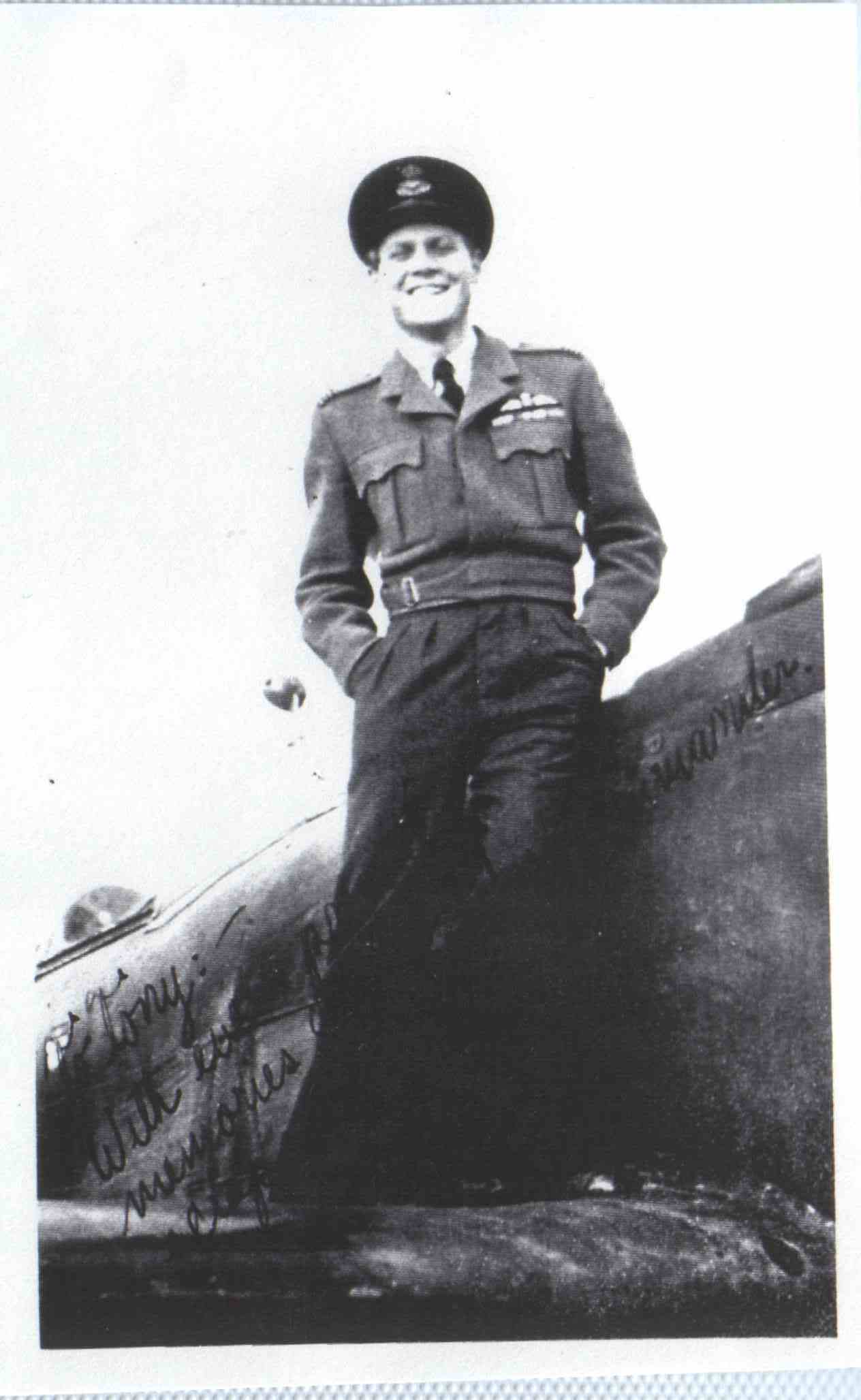
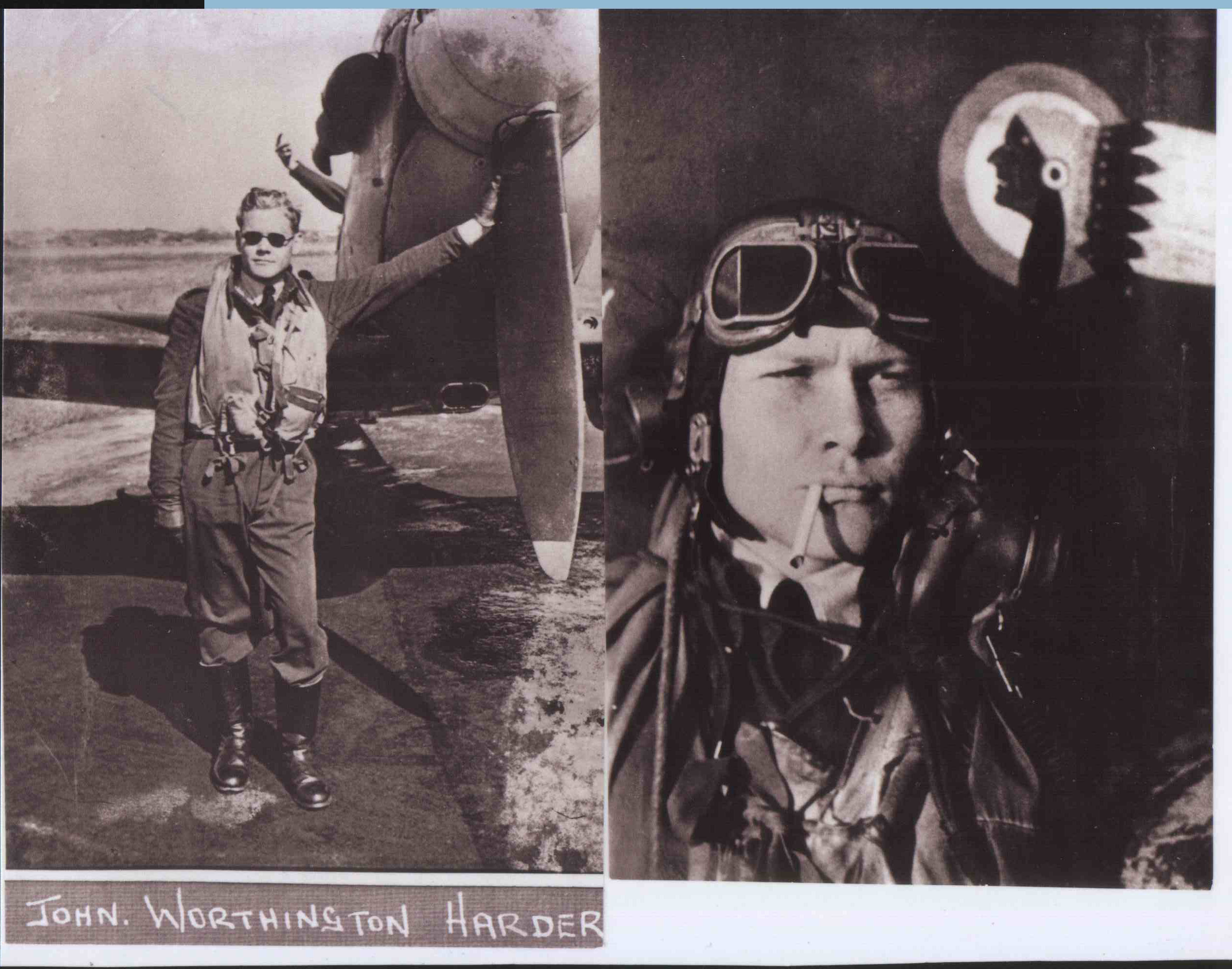
[See Flt Lt Harder looking relaxed with his Spitfire “L for Lechery”]
Harder already held a civilian pilot’s licence when he volunteered for the RAF in October 1941, aged just 18.
Choosing to stay with the RAF following America’s entry into the war, in mid-1942 he was sent to Britain, serving for a brief period with Coastal Command, before transferring onto heavy bombers. However poor vision caused him to be declared medically unfit – his letters also allude to some sort of accident.
Purchase of contact lenses corrected his short-sightedness, but these worsened his night sight. Perhaps surprisingly, in spite of his contact lenses, he was soon training to be a fighter pilot with postings to 17 (Pilots) Advanced Flying Unit at Watton, and then 58 Operational Training Unit at Grangemouth.
On 24th of February 1943, he was posted to No.64 Squadron, at Fairlop, to fly Supermarine Spitfires.
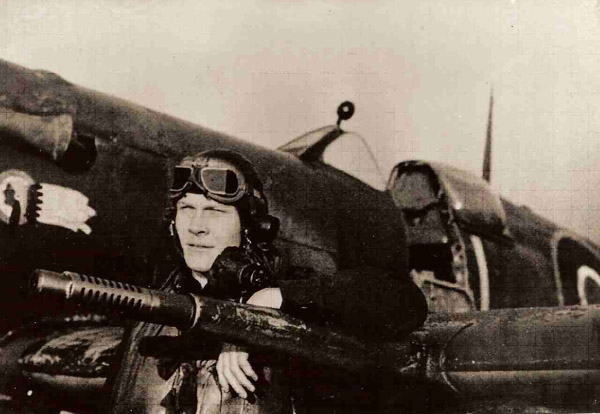
Harder immediately took to his new role, writing to his brother in the US military that he was now flying “Spitfire and all that. Afraid you have nothing to match them in all round excellence.” Being the youngest member of the squadron, he was known as “Junior” and had a crawling baby painted onto his Spitfire.
His first operational sortie is on the 11th of March – an uneventful escort duty for Whirlibombers (Westland Whirlwind twin-engined fighters adapted to carry two bombs) to Dunkirk. His next on the 12th – Rodeo 183 – was livelier as it involved an engagement with 17 FW 190’s 10 miles to the south of Dunkirk.
[See Whirlwind Mk 1 in flight]
19 April 1944, on a coastal patrol to intercept enemy aircraft and about 50 miles out, Harder’s aircraft developed engine trouble and caught fire. He had to bale out and use his inflatable dinghy, his only injury a slightly scraped knee. He was picked up by an RAF “Crash boat” and returned to duty.
Time in Normandy
On D-Day, the squadron role was providing low beach cover over the American assault on UTAH beach with the first of three runs setting out at 05.20 hrs.
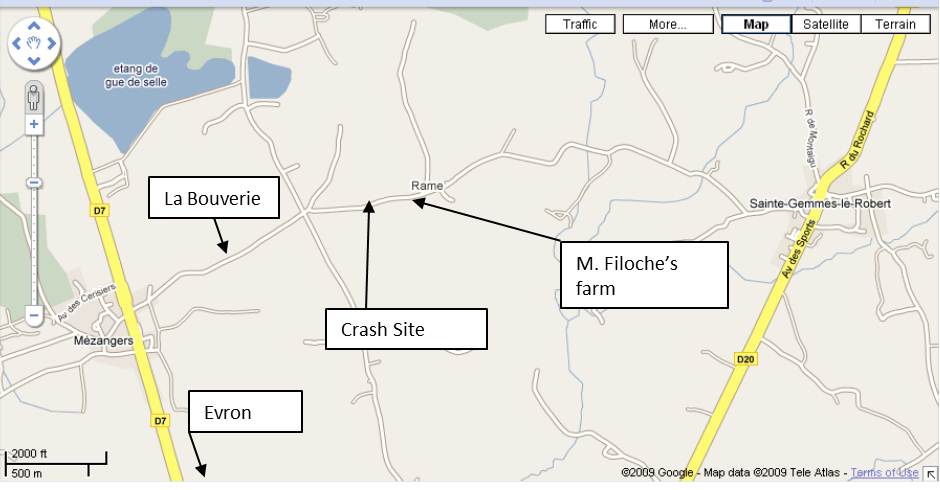
On the 24th July, Harder was shot down whilst involved in a sweep that took off from RAF Harrowbeer at 17.50 hrs and which culminated in an attack upon railway trucks at Voutre near Evron, Mayenne.
Harder landed near the village of Mézangers, which was occupied by the Germans.
[See map of John Harder’s crash site]
Fortunately, he fell in with a local farmer, M. Le Blanc, who took him to his home at Mortry and helped him contact the local resistance – Harder mentions being given advice by a Marcel Cholet (described as a carpenter from Evron).
At Mortry he was provided with civilian clothing.
On the morning of the 25th of July 1944 Harder leaves his uniform and parachute with the Le Blancs and sets out from Mortry (about 5 miles Northwest of Evron on the D140). He says he stayed that night at the house of a priest name Renaudier at Montreuil.
There is a record of a M. (rather than Father) Francis Renaudier of Montreuil-en-Lassay receiving a thank you letter for aiding British servicemen. Renaudier appears on the census for 1936 living at the Presbytere. At Montreuil Harder was fed and introduced to a local resistance figure (named as “Noel or Michel”) who gave him details of the best route to take after Harder had declined the offer of a guide.
Next morning, Harder sets off North travelling until he reached La Riviere where an unnamed farmer gave him food and shelter. The next day he made his way North then hid in a hedgerow near a German forward artillery position that night and throughout the following day, before attempting to cross the lines. Unfortunately, this was unsuccessful, and he was detained by one of the Germans. It was his twenty-first birthday.
For more, including Elledge’s description of his civilian clothing, see Harder evasion and capture. ?
PoW Life
When his identity was confirmed, he was taken to a barn where four American Servicemen were being held – Elledge, Gillespie, Sheppard and Willen. These five were then marched to “the Shed,” Where they stayed for a day and a half before being shipped out towards Germany via Alencon, Chartres (where the Army personnel were separated off) and Paris, where they resided on the mezzanine level of a railway station for a day and a half – probably la Gare de L’Est. Elledge describes their time here in his manuscript – mentioning using Harder as an interpreter at one point when conversing with a Red Cross lady.
There followed a six-day journey by rail to Frankfurt – 18 hours in peacetime but the Allied forces had damaged the track and the rolling stock extensively. The trains were running in constant fear of air attack – both Elledge’s and Willen’s accounts of the journey mention an attack by American aircraft.
[For more regarding the journey see precis of Elledge’s journey: Journey to Prison Camp] ?
Then to Dulag Luft at Obersel for interrogation. Harder speaks of several days of grilling whilst being held in solitary isolation, which was the norm for officers of his rank – those of a higher rank, such as Elledge, being given a much easier ride.
Eventually Harder arrived at Stalag Luft III, Sagan.
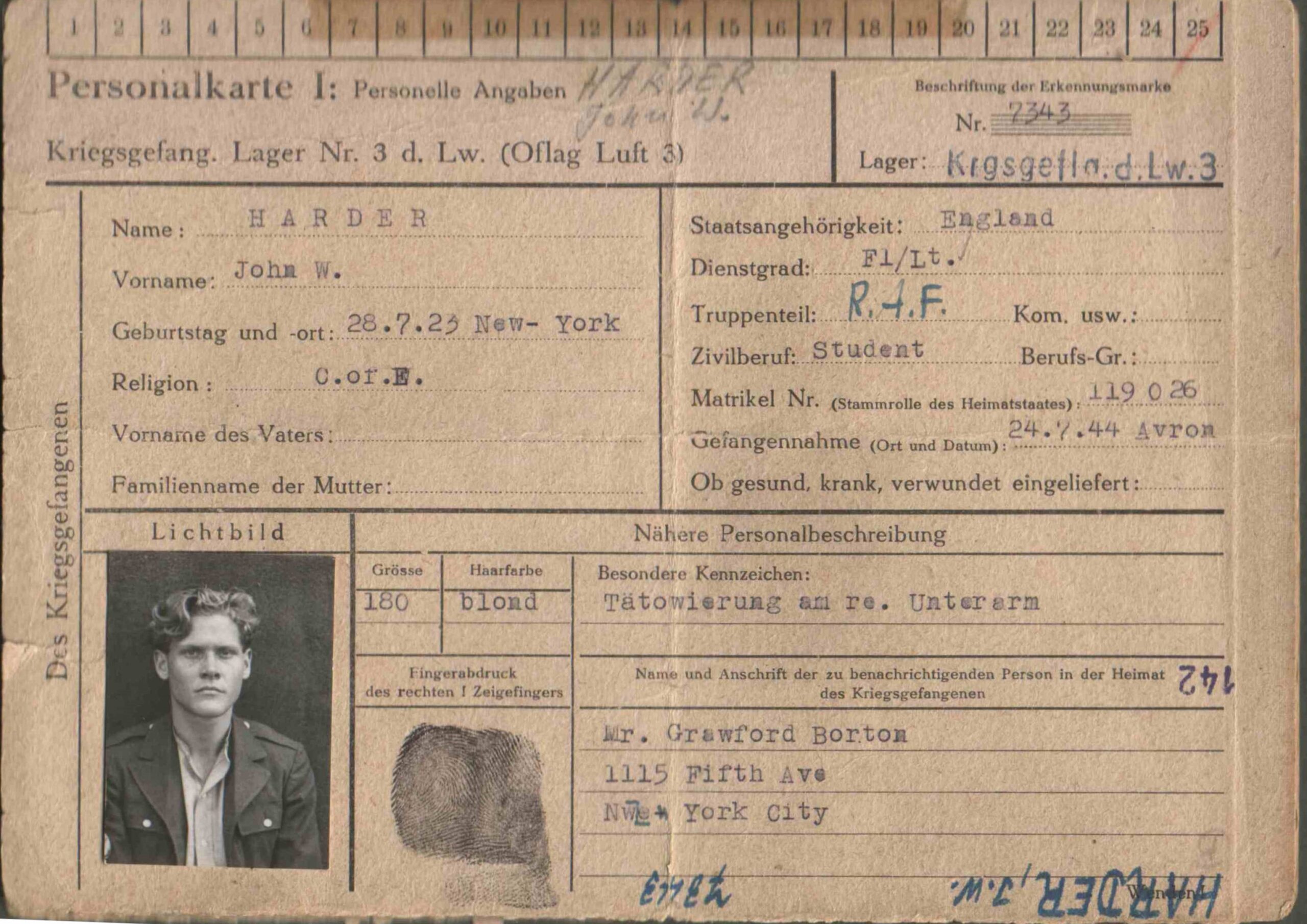
[See German PoW Card – JW Harder]
At Sagan Harder received one of the journals called “A War-time Log” issued by the World Alliance of Young Men’s Christian Associations. Like many other examples seen, much of the content is made up of imaginary menus, but it does include a brief statement of how he got there (which for our purposes unfortunately skips over his experiences in France), a list of his roommates, a list of the pilots in his squadron, and several signatures and addresses of other prisoners.
Link to PoW Journal
Link to pdf’s
1 Harder in 64 Squadron
2 Harder room-mates
3 Harder Journal other names
He was transferred to the satellite camp at Belaria. Later he took part in the notorious Long March, as the Germans moved their prisoners further away from the advancing Russians in the freezing conditions of the height of winter. As a result, he ended up at Luckenwalde (Stalag III-A).
Luckenwalde was “liberated“ by the Russians on 22 April 1945, but the Russians were reluctant to let the allied troops return to their units. Nonetheless Harder managed to slip away and make his way to American forces in early May – in a letter describing how he had to swim across a couple of rivers to do so.
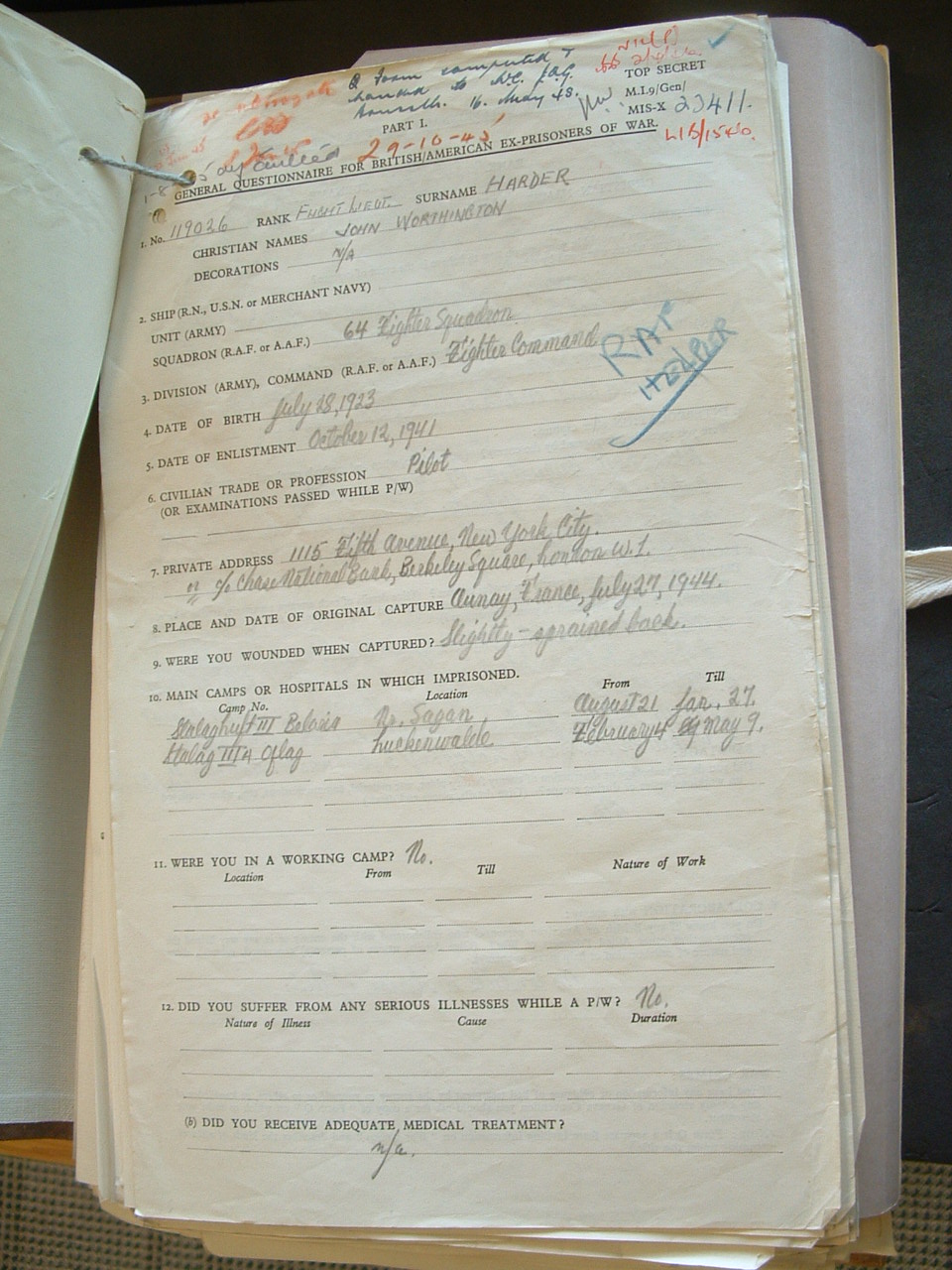
On return to England, he completed the usual returning POW questionnaire, and, as he had evaded for a period, a further M.I.9 de-brief.
In a letter home he describes himself in good health, though having lost a lot of weight.
Post War
Harder considered remaining in the RAF as a career option, and after a period of leave in America he joined No.567 Squadron. However, it is clear from his letters that he was feeling constrained by the routine and regulations of the peace-time RAF and consequently left the RAF in February 1946, but not before gaining experience in various jet fighters.
Family tradition is that he then operated as a mercenary for a period, but again there is no documentary proof of this.
Returning to the States he married in 1949, and the couple went on to have seven children.
Following a series of temporary jobs and a brief flirtation with banking, the next thirty years would see Harder pursuing a career in aviation – this would include: flying as an instructor in the Middle East; forming his own aviation companies; and, when he tired of running a business, working as an instructor and test pilot for Boeing. He retired from flying due to ill-health in 1970 and was employed, amongst other things, as an expert witness on aviation.
There are many more stories in the family relating to John – he was considered good company and an excellent raconteur – however finding proof in relation to some has proved elusive.
He died a few days short of his 54th birthday on the 25th of July 1977.
Research Done
This biography is in part based on that produced by the RAF Museum and a summary produced by Stuart Hadaway for an online exhibition.
Other Links
Harder signature and Flt Lt JW Harder DFC post war with Spitfire [return to info]
Flt Lt John Worthington Harder and Spifire [return to info]
64 Squadron RAF Crest [return to info]
Whirlwind Mk 1 in flight, loaded with 2 500lb GP bombs underwing, AAEE Boscombe Down [return to info]

Map of John Harder’s Crash Site [return to info]
German PoW Card – JW Harder [return to info]
Returning PoW Questionnaire – JW Harder [return to info]
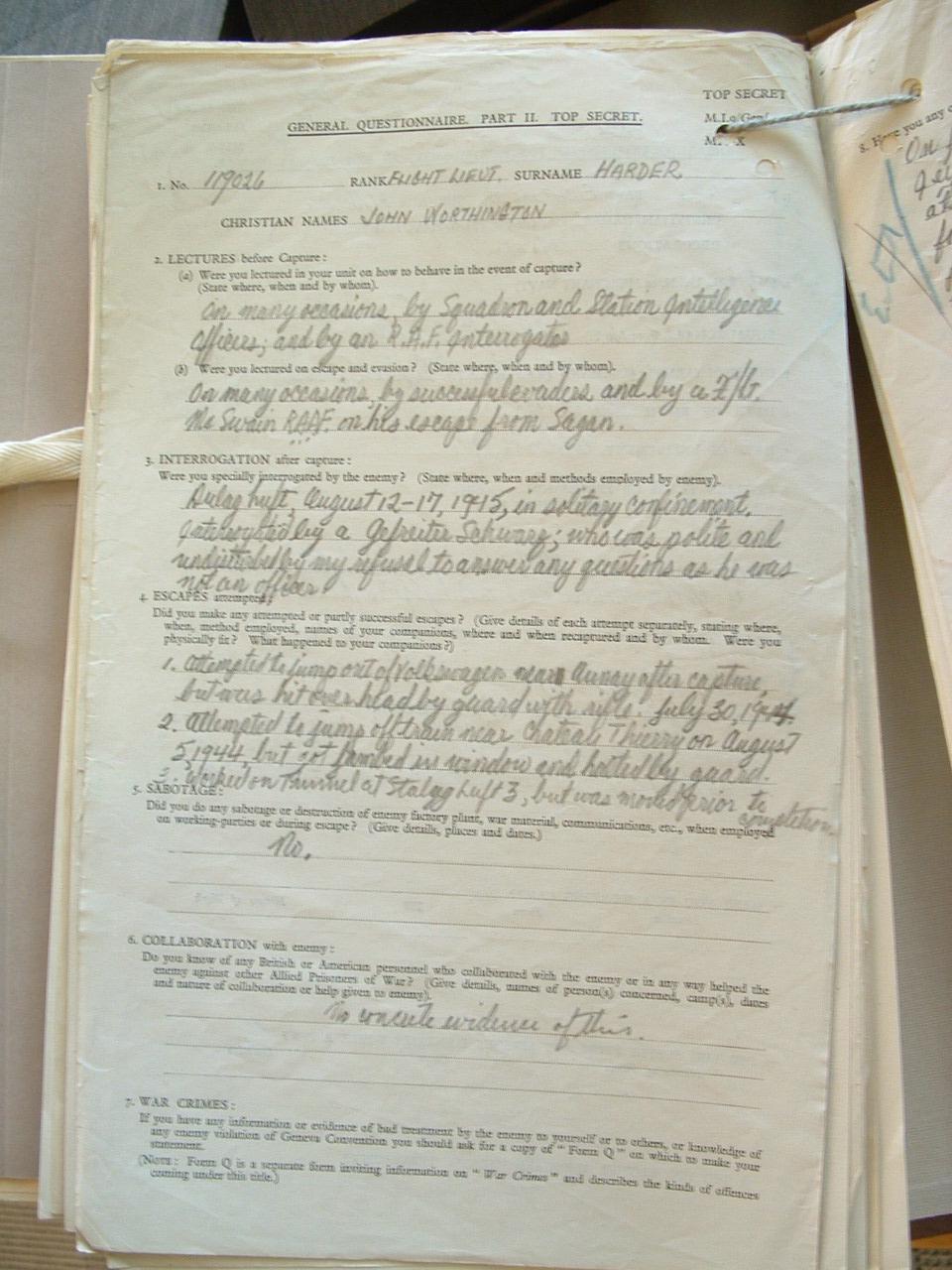
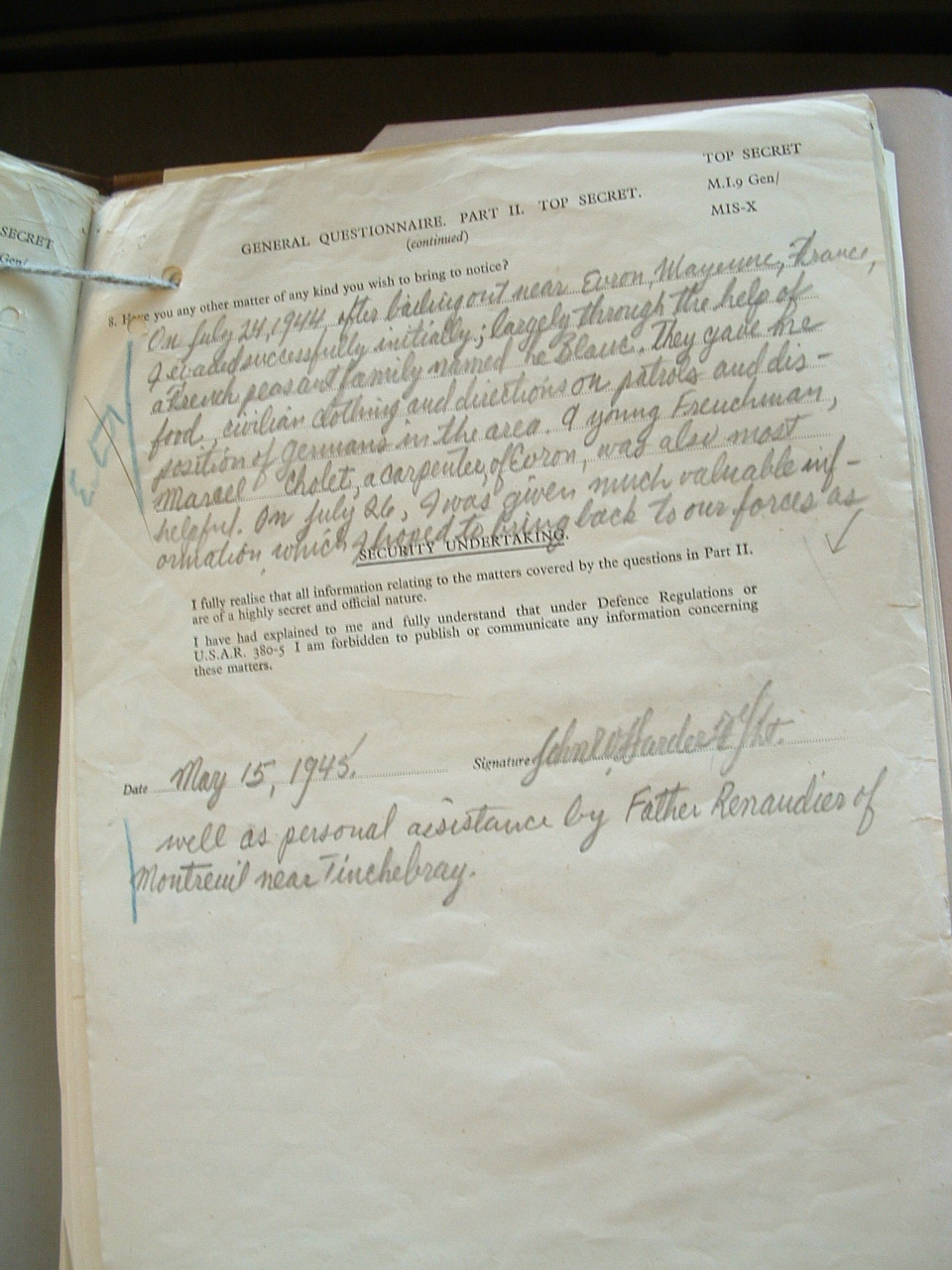
MI9 debrief JW Harder [return to info]