Normandy 2016. Day 11- Monday 6th June- A Day of Remembrance
As in past years, this was going to be a very busy day of Remembrance –this year it would include saving the Honour of the Welsh Guards! But more of that, later!
Honouring the fallen at Hottot Les Bagues
We started wit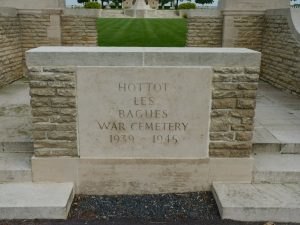 h a visit to Hottot Les Bagues Commonwealth War Cemetery and the first of our Remembrance activities. This is where a lot of the fallen from the fighting near Tilly & other villages were buried. It is also the resting place for most of the Guardsmen from 6th Guards Tank Brigade (& especially from “S” Squadron, 3rd Bn Scots Guards) who lost their lives at the start of Operation BLUECOAT. Three JagdPanthers ambushed their Churchill tanks on Hill 226, just n
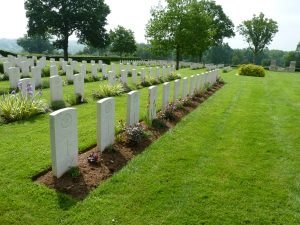 ortheast of St Martin des Besaces. They lost 11 tanks in 5 minutes & 25 Guardsmen were killed or later died of wounds.
It’s always an honour to visit such cemeteries, particularly at this time of remembrance. But this year, it was a special honour as we were there on behalf of Muir Findlay – a veteran of the battle – & someone who we’re very proud to call a friend. Unfortunately, he’d not been too well & so this year, he was unable to travel to Normandy. So his son, Eain, had asked if we would mind visiting on their behalf, which we were more than happy to do.
We took some photos of the grave of Private Alfred Worsdale, 4th Bn Somerset Light Infantry, killed on 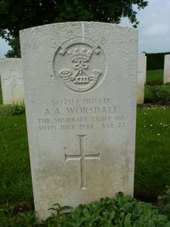 the same date as the Scots Guards mentioned (30th July 1944). This was for a friend of Eain’s.
Following a period of quiet contemplation and Remembrance, we realised how quickly time had gone by. So set off and called into Villers Bocage to grab some food for lunch.
On the trail of the American contingent of the Men in the Shed
We then decided to try to get back onto the trail of Raymond Elledge, Gerald Willen, Morris Sheppard & Francis Gillespie.
First a brief recap. After they’d left “Chaimps de Champs” (identified as Le Mesnil Clinchamps) they worked their way through Vire. They then headed north towards the Allied lines. They had just gone through Villiers Bocage… Raymond takes up the story.
“On Willen’s return, we ate and resumed our journey. When we had walked a kilometer and a half a buggy with two German officers passed heading in the opposite direction. We did not pay any attention to them. And they — we thought — were not paying any attention to us. We walked two or three minutes when the officers turned their buggy around, stopped, and summoned Willen and me.
The German officer on our side asked where we were going. Willen, speaking French, told the German officer that we were going up to the next village. The German officer asked Willen why we were going there. Willen, on the spur of the moment, told the officers we looking for our cow. In the meantime, Gillespie and Sheppard, who had been walking 100 yards behind us, saw the officers stop us and, to play safe, went into the woods along the side of the road.
The officer asked Willen the name of the next village. Willen told him Villers-Bocage, the name of the village we had just walked through. Willen, unfortunately, did not know the name of next village that could be seen over the rise of the trees. The German officer pulled out a map and said, “You must be mistaken, you have already passed through Villers-Bocage — only a kilometre back down the road”. He suspicioned that we were not Frenchmen living in the area. Locals would have known the names of two villages.
He began accusing us of being “Terrorists” — French people behind the lines who were sabotaging German equipment. Becoming more heated, he pulled out his gun and started waving it in our faces, cursing, and threatening to shoot us. When we thought he was going to shoot us. We produced our identification tags to prove we were American soldiers and not spies. He seemed astonished and surprised and ordered us into his buggy and we, again prisoners of war, were off to a nearby farmhouse.
Gillespie and Sheppard came out of the woods, looked down the road, and — not seeing us nor the German officers — assumed Willen and I had kept on going. They continued on until some German soldiers — with instructions from the officers — picked them up and brought them to the same farmhouse.
The four of us were corralled in a barnyard, surrounded by the house and a large barn with stables and harness rooms on both sides. We were searched and the sacks with food were taken away. The German soldiers thought it funny that we were carrying food in sacks and dressed as French peasants.”
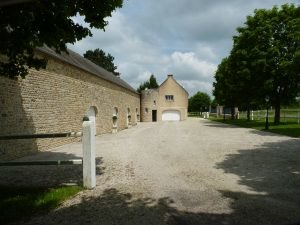
So, Glyn & I wondered whether we could find this farm from Raymond’s description. There are three routes north (or northish) out of Villers Bocage, of which two are more major routes. So, given the time that we had available, we decided to try the two major routes out of town. We would follow them for a couple of kilometres to see if we could find the sort of building complex mentioned.
Midland Red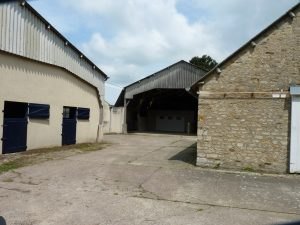 Bus syndrome
So, there we were, hoping to find a nice suitable candidate. We did… but there were three of them; and that was without looking at anything along the third route! A bit like the old saying about Midland Red busses: You wait ages for one and then three arrive at the same time!
However, I wonder whether, with hindsight, we could discount the one -for two reasons.
- First the road is more east, or north east, rather than north.
- Secondly, on this road in June, Michael Wittman’s Tiger Tanks ambushed the advanced elements of the British 7th Armoured Division. Many tanks, halftracks & carriers were completely destroyed. Elledge did not mention anything in his manuscript. They would have been walking alongside the evidence of the carnage – I can’t see that it would have been cleared away at this point. I would have thought that it would have earned at least a passing comment.
So, some further research required. Firstly, we must identify when the wreckage from 7th Armoured Division was moved. Secondly, estimate travel distances by applying a compass to maps. Thirdly, review wartime aerial photos to try to identify potential places. Plus the many other things that would come to mind.
A quick visit to L’Odon Brewery (well it would be rude not to!)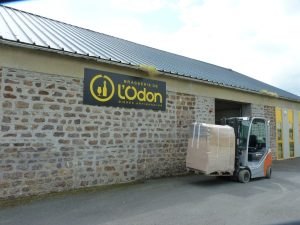
So, we now headed south towards our regular 6th June afternoon appointment at St Charles de Percy Commonwealth Cemetery for the Ceremony of Remembrance. On route we stopped as, just outside of Villers Bocage, on a small industrial estate was a sign advertising the l’Odon Brewery… well, you wouldn’t expect us to drive past, would you.
A quick call in – the brewer was delivering some training, so couldn’t spare us much time – and 5 minutes in the shop & we were back on our way!
At St Charles de Percy and saving the Welsh Guards
We arrived at St Charles de Percy for their Ceremony of Remembrance. I went over to the mayor & passed on Muir Findlay’s apologies. M DESO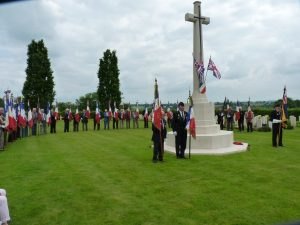
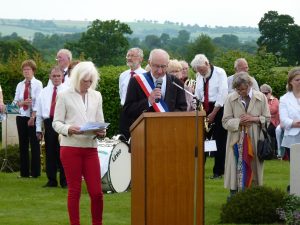 RMEAU was disappointed to hear this – especially as Muir was the only WW2 veteran that they were expecting. However, he fully understood that Muir’s health had to come first.
This year, the Welsh Guards had sent 4 Guardsmen and, unexpectedly, two Irish Guards had turned up. One of the Welsh Guards played Last Post on his bugle. As ever, hearing the mournful notes sounding out across a quiet cemetery sent a shiver down the spine.
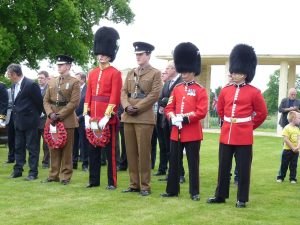
Following the Ceremony of Remembrance, which was as “French” as ever, we set off into the village proper for the Vin d’honneur at the Guards Memorial. However, there was no sign of the Guards. Well, the two Irish Guardsmen appeared, saw the crowd, turned round & walked off. I suspect that they thought that it was a private ceremony. Meanwhile the villagers (including the Mayor) were beginning to look concerned as they were waiting for the Welsh Guards to arrive before starting.
So, I jogged back to the car (yes, I know, hard to believe!!) and drove off in search of them. Fortunately, they were at the top of the lane chatting to the son of an Irish Guards veteran –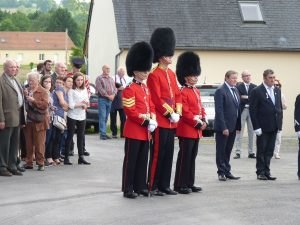 Major Tony Brady. The son was visiting in memory of his father who had passed away last year. I explained that the mayor & villagers were awaiting their arrival before starting the ceremony. Whilst I offered them a lift, they said that they would march. By the time that I’d turned the car around, they were half way there!
Ceremony over, the Lieutenant in charge of their party thanked me for coming to find them. They did not know of the second ceremony. They thought that there was just one – that at the cemetery. During the Vin d’honneur, I was introduced to a couple of locals that used to live in St Vigor. They had no idea about the Shed… so they were introduced to Stuart & Barrie who were at the ceremony.
Off to Ryes
Unfortunately, we couldn’t stay long. We needed to 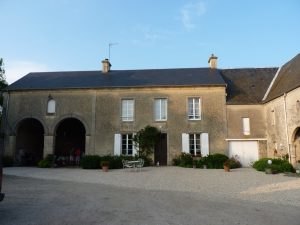 head off to Ryes which was near the coast for our overnight accommodation.
Our accommodation was a converted barn. Part of a massive farm complex owned by Mme Emmanuelle Sébire. Again, I had to use my budding French language skills as Mme Sébire didn’t speak much English. The rooms had been converted in a simple way that was comfortable, but which preserved the fabric of the building.
We were then off a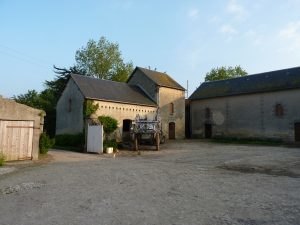 gain, to grab a late meal in Asnelles at Dunes Zen.




Recent Comments