So, having met Sam & Martha for a meal last night, today we were off in the footsteps of Martha’s father – Major Raymond P Elledge Jr. In many ways, today was all about the whole point of this project. Giving back to the family of one of the men that were held in the shed a small piece of their family’s history.
At Airfield A-5: La Chipelle – Raymond Elledge’s final flight
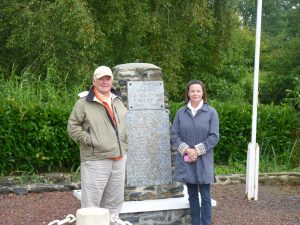
Sam and Martha Bowen (daughter of Major Raymond P Elledge) at the memorial marker for Advance Landing Ground A5 at La Chippelle
Our first point of call was St Martin de Blagny. At the church, there is a memorial to the airmen from the 404th Fighter Group who flew from airfield A-5, La Chipelle, The Group that included 506th (Elledge), 507th & 508th(Gillespie) Squadrons. The church is at the North Eastern edge of the airfield which is now hidden behind some trees.
From there we drove to the South Western corner. Here there is a further memorial to the airfield and the men that flew from it & didn’t return.
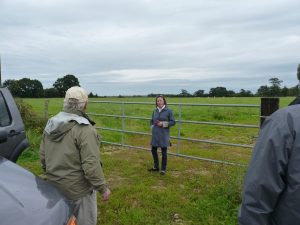
Sam and Martha Bowen (daughter of Major Raymond P Elledge) at the mid-point of Advance Landing Ground A5 at La Chippelle. In the background, the hedges have not been replaced where the runway used to be
From aerial photographs – whether Google or the French IGN – it is possible to still determine the location of the runway. There are still the gaps in the hedgerows where the engineers cut through to allow the runway to be built. We then drove around the western perimeter of the airfield & along half of its northern edge. At this point road now cuts through what would have been the centre of the airfield. Stopping half way along this allowed us to get a real “feel” for its location. You could also see that Martha had been taken back in time. To when her father used this runway in his daily routine to fly interdiction patrols in his P47 Thunderbolt. Whilst there was far less to see than on her & Sam’s previous two days of battlefield touring, you could see that this was Personal.
The Expert
We then called in at one of the farms that is now within the perimeter of the airfield. They pointed us towards a local gentleman – “an Irishman living in Normandy who was an expert on the area”. We went to his house but, unfortunately, he wasn’t in. S0 I left a card and a brief explanation of who we were & what we were doing, with a request that he contact us. Apparently, he didn’t see the note until Monday when the farmer popped in to tell him about our visit. He then called straight away but we’d just dropped Sam & Martha off at Caen railway station with their friends. It turned out that he was Edward Robinson – a Normandy Tour Guide and is very interested in making contact with Martha as he’s researching Airfield A5 in depth.
Raymond’s Crash site
Next stop was to try to find Raymond Elledge’s crash site.
You’ll recall that Glyn & I had thought that we’d found this only to find that it was a post-war pig farming operation. So, we went back to the drawing board & found some wartime maps which allowed us to more closely pinpoint the site. We headed there for a look around.
However, in June, we had been given the contact details for Mme Suzanne Germain who lived locally. As a child she saw an aircraft crash nearby. So I’d written to her, & Stéphane Jacquet had also been in touch. Stéphane was to have been with us but his father was ill.
So now it was time to visit Mme Germain. Fortunately, a neighbour – Mme Chautal le Bel – was on hand to help with some translations.We determined that, whil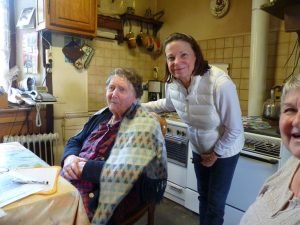 st she had not actually seen the aircraft crash, she had seen a wing on the ground. Raymond Elledge had made use of two trees to slow him down following his hitting the ground
 , so, seeing a separated wing made sense. Therefore, we decided to take this at face value & go and look at the site.
Mme le Bel took us to a small track leading up to a farm – one that Glyn & I had visited with our friend Benoit during one of our first visits to Normandy. However, rather than going all the way up the track, we parked on the side of the road & walked into the field in the corner made by the track & the main road. It was here that Mme Germain had seen the remains of the aircraft. Unfortunately, there’s nothing left visible now, but we’re hoping that one of our Normandy friends – JeanMarc Lesueur might be able to arrange a visit with a metal detector.
“The Monastery” or “Starvation Hill”
Next i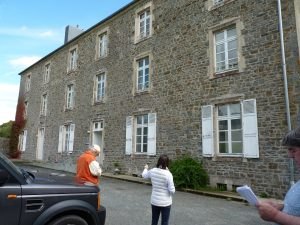 t was back into the car for a quick trip across country to the village of La Chapelle sur Vire. To the German PoW concentration area known as “The Monastery” (Elledge calls it “The Nunnery”). We’ve visited here on a number of occasions, so I’ll not go into the full details again. Suffice it to say that it was quite moving watching Martha walk around the place imagining Raymond being there. Then escaping from it with Gerald Willen, Morris Sheppard & Francis Gillespie.
Finding more at Le Mesnil Clinchamps
Although he wasn’t able to be with us, Stéphane Jacquet had contacted Mme Marie-Josèphe VIARD, the Mayor of Le Mesnil Clinchamps. Elledge’s “Chaimps de Champs”. She said she was pleased to welcome us to her village, despite it falling on Sunday.
At first broken French & shaky English made communication difficult. Then the Mayor’s son – Laurent – arrived to translate, and things became much easier.
Harold Wellek
A couple of calls & some digging resulted in Mme Viard being able to identify another building t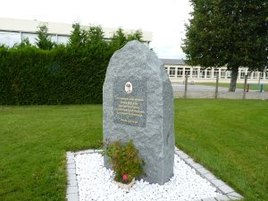 hat had eluded us on a previous visit. The home of the Town Banker M. Roquet. However, before going there, she asked if we’d like to see the memorial stone that had been erected in 2014 to an American pilot – Harold Wellek . His P47 (the same type of aircraft to that flown by Raymond Elledge & Francis Gillespie) was shot down by German Flak. In order to avoid crashing into the buildings of the village he stayed in his aircraft. Flying it away from the village until it crashed. Unfortunately this action cost him his life. Here is a document that describes the unveiling, written by a relative of Wellek who attended the ceremony.
Field Hospital
Then, as we were passing, Mm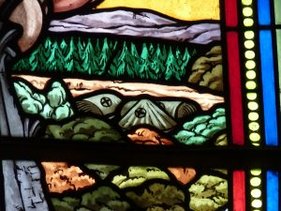 e Viard asked us if we’d like to see inside the village church, we said yes. We were glad that we did. One of the new (post war) stained glass windows shows the location of an Amer
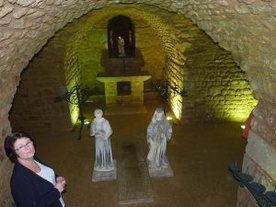 ican Field Hospital that was set up following the liberation of the village. We then went into the crypt of the church – which was also interesting.
The Banker’s House
So then it was back to the cars. Then a brief journey to the house that Mme Viard had identified as belonging to M. Roquet.
I was a little surprised. On our first trip there we had found the barns & the culvert where Elledge and the other escapees had picked up the bicycles on their journey back towards Allied lines. This was 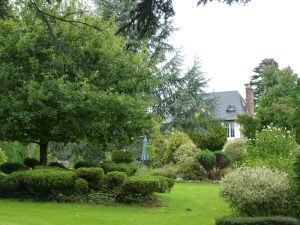 near the house of the Roquets, and to get there we had gone in the opposite direction. However when we arrived and I walked across the road, I spied a culvert under the railway. Checking with my map, this was the same one. Basically last time we’d gone round part of a circle & today we’d nearly completed that circle heading the opposite way! So I was happy! Also, the status & size of the house, even by today’s standards was large. So back in the 1940’s it would have seemed to be more imposing.
We searched for some trace of the “Cave” where Elledge and the others hid for several days. Unfortunately nothing could be found. Perhaps that will turn up on another visit!
So, at the end of a fantastic day. One that Martha & Sam had so obviously enjoyed. We set off to Tony & Jill Stansfield’s B&B our accommodation for the evening; tired but happy.




Recent Comments